
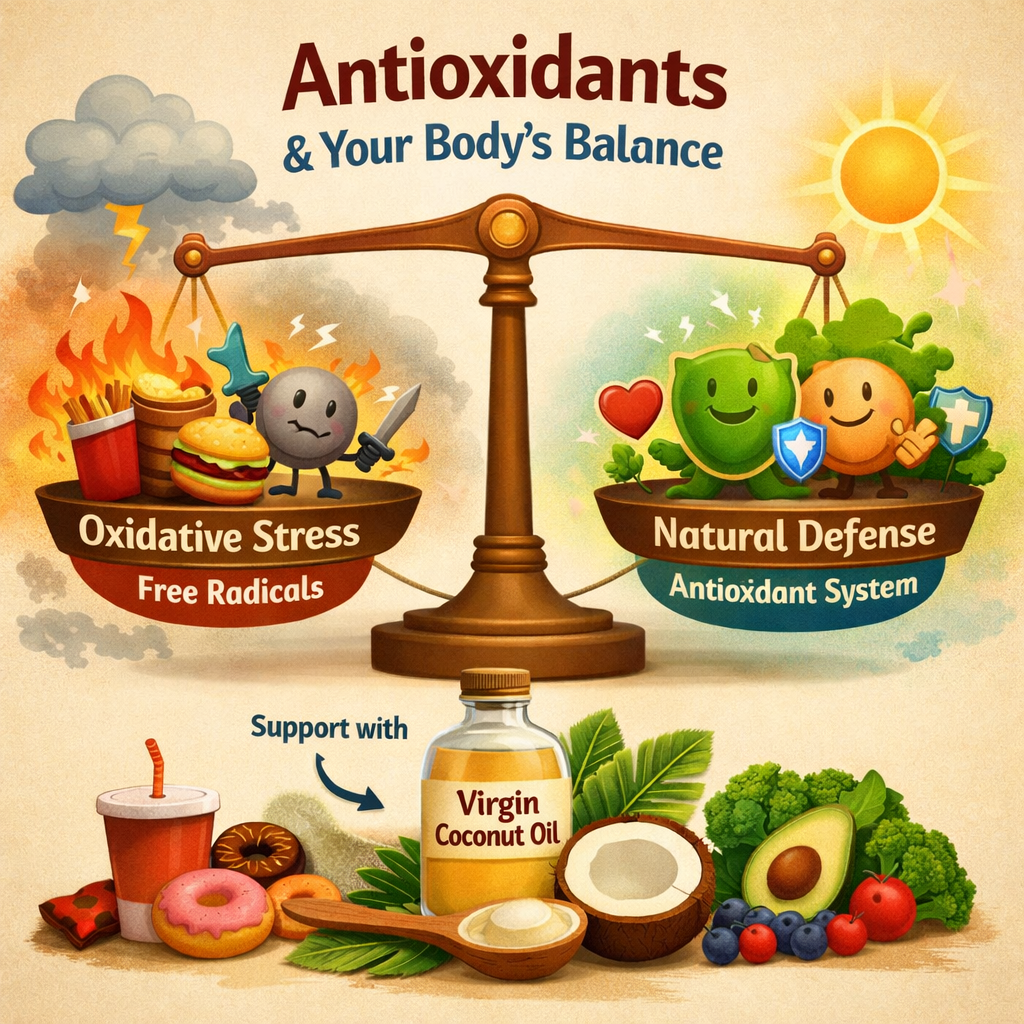
What Do We Usually Mean by “Antioxidant”?
When we hear the word antioxidant, most of us think of:
- berries
- green powders
- supplements
- labels saying “rich in antioxidants”
But here’s a rarely asked question:
How did our ancestors manage without all this?
No capsules.
No imported superfoods.
Yet they lived, healed, and survived.
So what were they relying on?
Does the Body Have Its Own Antioxidant System?
Yes.
The human body has a built-in antioxidant defense system.
It has existed long before antioxidants became a product category.
External antioxidants were never meant to replace this system — only to support it when needed.
Why Does the Body Produce Free Radicals at All?
Think of it like this:
- A car engine burns fuel → smoke is produced
- The human body burns food → free radicals are produced
A small amount is normal and unavoidable.
Problems begin only when too many free radicals are produced — a state known as oxidative stress.
This is where long-term damage risk increases.
What Are Free Radicals (Simply Put)?
Free radicals are unstable molecules missing an electron.
To stabilize themselves, they pull electrons from healthy cells:
- proteins
- cell membranes
- DNA
An easy way to imagine them:
Blind-folded people holding swords — damage is unpredictable.
What Do Antioxidants Do?
Antioxidants neutralize free radicals by donating electrons.
In effect, they reduce damage — but they do not eliminate free radicals completely.
And that’s intentional.
Are Free Radicals Always Harmful?
No.
Free radicals are required for:
- immune defense
- cell signaling
- healing processes
- blood vessel regulation
So the goal is control, not elimination.
Why Not Just Consume More Antioxidants?
Because excess antioxidants — especially from supplements — can:
- interfere with natural repair mechanisms
- blunt immune responses
- disrupt normal cellular signaling
This is why antioxidant supplements are usually need-based, not meant for daily, long-term use.
When Does Oxidative Stress Become a Problem?
Oxidative stress builds up when one or more of these are common:
- Frequent consumption of processed or chemical-laden foods
- Poor internal antioxidant capacity
- Overuse of external antioxidants without understanding need
Signs Your Antioxidant System May Be Strained
(These are signals, not diagnoses)
| Area | Balanced | Possible Strain |
|---|---|---|
| Skin & Hair | Healthy glow, age-appropriate changes | Early wrinkles, pigmentation, greying |
| Immunity | Rare illness, fast recovery | Frequent infections, slow healing |
| Energy | Stable through the day | Fatigue, brain fog |
| Joints | Flexible, pain-free | Stiffness, unexplained aches |
If the Body Has a Defense System, How Do We Support It?
The key is reducing internal overload, not fighting damage after it occurs.
This depends on how the body produces energy daily.
How Food Influences Free Radical Load
When the body is constantly overloaded with:
- excess sugar
- frequent snacking
- poor-quality fats
it produces more metabolic waste — including free radicals.
The solution is not extreme dieting, but metabolic efficiency.
Why a Small Metabolic Shift Helps
When the body is not always burning sugar, it partially shifts to burning fat.
This mild shift leads to the production of ketones.
Ketones:
- reduce internal oxidative stress
- improve cellular efficiency
- lower free radical generation at the source
Where Do MCTs Fit In?
MCTs (Medium Chain Triglycerides):
- go directly to the liver
- require minimal digestion
- are quickly converted to energy
This allows gentle ketone production — without forcing the body.
Why Virgin Coconut Oil Is Relevant
Virgin Coconut Oil is a natural source of MCTs.
- ~50–60% MCT content
- stable fat
- traditionally used in tropical diets
Studies show that pure virgin coconut oil, when used appropriately, can:
- reduce lipid peroxidation
- support antioxidant enzyme activity
- improve metabolic balance
Not as a treatment — but as support.
A Simple, Sustainable Practice
No extremes. No hype.
- 🥄 ½ tablespoon pure, raw virgin coconut oil
- 🌅 Taken in the morning
- 🍽️ Along with balanced meals and good sleep
Important:
- Works only if the oil is truly pure
- Supports — does not replace — nutrition
- Works best with lifestyle consistency
Frequently Asked Questions
Is virgin coconut oil an antioxidant?
No. It supports antioxidant systems indirectly.
Can this replace fruits and vegetables?
No. They work together.
Will taking more work faster?
No. Excess can backfire.
Is this suitable for everyone?
Individual responses vary.
In Short
Your body is not broken.
It doesn’t need constant fixing.
It needs:
- less overload
- better fuel
- and consistency
When we support the body instead of fighting it, balance follows — quietly and sustainably.